
Tuesday, March 10, 2015

Ancestry ---finding out who you are


Who are you?


Who are you and where are your family roots? Learning about our ancestors can be a fun and rewarding activity. With all the tools now available on the internet, it is easier than ever to find your roots. So, how do I get started you might ask. To simplify your record keeping and direct your efforts the first thing you should do is get 2 essential forms.

The first is an Ancestor or Pedigree chart. An ancestor chart records the ancestors from whom you directly descend--those for whom you intend to compile a complete and correct family unit. It shows at a glance the progress you have made towards this goal and what remains to be done.

The second is a Family Group Sheet. Each piece of information concerning a pedigree ancestor and his/her family is placed on a worksheet. Since the end result of your research efforts will be to compile complete, correct and connected families, the use of family group sheets from the beginning will make the compilation much easier.

Both of these forms are available for free from Ancestry.com at: http://www.ancestry.com/download/charts#ancchart


Once you have the forms, fill them out starting with yourself. If you want help, the North Berkeley Library will be hosting a Genealogy Club starting in March. Whether you are a seasoned pro or just thinking of getting started we would welcome you to join us.

The initial format for the meetings will be a 15 to 30 minute training video followed by a discussion. Our first meeting will feature a video and discussion on how to get the most out of Ancestry.com. Follow on meetings will cover topics of interest to the membership.

The club will meet monthly on the second Wednesday at 1 pm. Other times will be considered if there is suffient interest. If you are interested please let your librarian know what days and times are best for you. 

Bring your laptop or tablet, or use one of the library's computers to begin or continue your research.  A library staff member will be available at the meetings to assist you if you need help.

-Tom Brown

Monday, March 9, 2015

Children's Corner: The Many Faces of a Topic

Children’s Corner: The Many Faces of a Topic


Once kids get to a certain grade, projects and science and social studies fairs pop up, requiring RESEARCH.  Gasp!  Horrors!  Research needn’t be a wretched business, and here’s why.  As many of you know, the facts in our library are arranged by subject matter according to the Dewey Decimal System.  Starting with the 100s and going through the 900s, each number refers to a general subject.  While helping your kiddo get the most out of their research, make sure to look at a given topic from its many angles.  Let’s try ancient Egypt.  Here goes…
Check the 100s, containing information on, well, information.  Ancient Egypt was a giant of its time, imparting timeless knowledge that we continually reference and glean insight from.  Move over to the religion section, in the 200s.  Osiris, Isis, Ra, Set...like ancient Greece and Rome, Egyptian religion was polytheistic, a colorful sub-topic to check out.  Next the 300s which contain topics of a social nature.  Mummification was reserved only for those who could afford it, and many other cultures practiced it. 


Now, the 400s: language.  One of the most striking language discoveries was that of Egyptian hieroglyphs, containing images that are easily recognizable today.  You’ll see the 500s contain everything science, giving us several things to look for concerning ancient Egypt.  Studies of the stars, mathematics, not to mention the climate and the famous Nile River.  The 600s contain information galore on health and technology – the pyramids!  There are several theories exploring how these massive structures were built.  And the 700s explain all about architecture, arts, and entertainment.  The ancient Egyptians were a very visual people, the images endure today; not to mention their fascinating pyramids and statues.  What could literature tell us in the 800s?  Ancient Egypt with its life-giving Nile, papyrus plants, Valley of the Kings, dusty sun-baked structures of antiquity has spawned countless poems and works of fiction.  Finally, the 900s is likely the place where one would begin researching any nation, as it is all things history.  If you begin in one place, don’t stop there; information is always there for those who look!


3.6.2015  Erin K Henry

Young Adult Award winning sci-fi


YA SKULL SESSION: EXPLORE AWARD-WINNING SCI-FI!

Science fiction literature is a fantastic platform on which to explore points of view, with its characteristic ability to explore themes ranging from morality of war, genetic experimentation, dystopias, and countless other social issues.  The genre has become increasingly popular in Young Adult literature circles, most recently with the popularity of Suzanne Collins’ The Hunger Games, James Dashner’s The Maze Runner, and James Patterson’s Maximum Ride, to name a choice few.  Character focus, as in The Hunger Games, is often on children, but the age-range is endlessly explored and applied.  Here is magnetic appeal for teens: characters of their age in fantastic situations that are often full of drama but many times credible; with adult characters, teens have the advantage of witnessing a possible adult self making life-changing decisions, at times visceral and ruinous.  Authors have long explored the morals of present-day society, its governing bodies, choices of the past, social ecology, and cultures.  Here are three classic examples, all of which won the Hugo Award for best Science Fiction Book of the Year.

Let’s start with a familiar title of late: Ender’s Game, by Orson Scott Card, brought to screen in 2013.  Published in 1985, it’s the first in the Ender Wiggin 
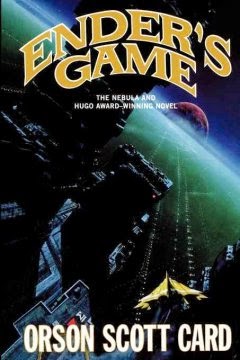
series of eight novels.  Andrew “Ender” Wiggin is a young prodigy living on an Earth that is threatened by extraterrestrial beings called Buggers.  As a way of mustering a competent and effective military, children are raised playing simulated war games and monitored continually.  This internal monitor tracks their aptitude for war strategy and military leadership.  Young Ender is selected, among others, to train for the upcoming battle.  His natural expertise in simulated war strategy and ability to organize his fellows into an effective unit attract attention, earning him the leading role (the General, if you will) of Earth’s child prodigy soldiers.  None of the children, however, are privy to the grand plan of their training; the repercussions are devastating.  Ender’s Game raises questions regarding personal privacy, exploitation of children, national security, and war as a means of keeping this security – all topics that were, are, and promise to remain hot.


Another sci-fi classic brought to screen (numerous times) is
Robert A Heinlein’s Starship Troopers.  


Also focused on waagainst alien bugs, Heinlein writes as Johnny Rico, an older
teen who enlisted as an interplanetary soldier.  The plot
recounts Rico’s time as a mega-soldier (think Iron Man)
in this war against the Bugs, relating his experiences on an
external and  internal levels.  The story is not all action, inviting
a larger audience and deep discussion.  Heinlein is not afraid to
use this novel as a platform for strongly stating his opinions on
the morals and philosophy of war, military order, capital
punishment, and reigns of terror and force.


Lastly, I will tell you about A Canticle for Leibowitz, by Walter M Miller
The oldest of the three, published in 1959, the story is no less current. 
Earth has suffered a nuclear holocaust and humanity is clinging to life in several disconnected and often warring regions; the story is told in three successive spaces in time meant to reflect actual times in history.  At the heart of the plot are the monks of the Order of Saint Leibowitz, striving to preserve the remnants of civilization.  They spend their days recording, sometimes sharing, and protecting the history of the human race.  Like Ender’s Game and Starship Troopers,

Leibowitz has an atmospheric and world-building story line, but Miller deftly crafts his novel close to the dark inner-workings of the human heart.  The end times, he suggests, are brought about the selfish, clutching, power-hungry actions of humanity, and it is from this angle that he spins a bleak and chillingly realistic tale of a ruined Earth.  Teens will remember this book as one of the most striking they’ve encountered.

All three of these novels are bound to provoke lively discussion, if only in one’s mind, of the morals of weapons and war, using war as a means of security, the effects of war on the individual and populace, and causes of human suffering.  Though science fiction is, in name, fiction, the questions is raises and emotions it evokes are very much real.

More oldies but goodies of the Sci-Fi lit world recommended for YA’s:
1984, by George Orwell (1949)
Brave New World, by Aldous Huxley (1932)
A Clockwork Orange, by Anthony Burgess (1962)
Fahrenheit 451, by Ray Bradbury (1953)
Out of the Silent Planet, by C. S. Lewis (Space Trilogy #1) (1938)
A Princess of Mars, by Edgar Rice Burroughs (Barsoom series #1) (1917)

3.6.2015 E K Henry

Sunday, March 8, 2015

What's new--Harold the Bear--March 8, 2015

Harold the Library Bear celebrates K9 Veterans Day


Hedgesville, WV – Today I found Harold the Library Bear surrounded by books about dogs. When I asked him why he was reading so many, Harold shared this interesting story:

“I’m reading about these dogs because March 13th is K9 Veterans Day,” he said, “The librarian told me that a veteran is someone who serves in the military, so I thought it would be a great time to read all of the books in the Hedgesville Library about  veteran dogs!”

“This is the one I just finished reading,” Harold said, pulling a book from his pile and proudly holding it up. “It’s called Gabe: The Dog Who Sniffs Out Danger,” he said. “It’s all about Gabe, a dog that goes to another country and uses his really good smelling to help soldiers find dangerous things that they can’t smell!”

“Do you know what the coolest thing about this book is?” Harold asked.

“This book is a true story, because Gabe was a real dog! In fact, he was so good at his job that he won an award called the Hero Dog Award!”

“I think this one is my favorite dog story so far,” Harold said, “but I still have lots more to read! 

There a book about Sadie, a real life police dog, and a book about search and rescue dogs too!”

“Of course, there are also a bunch of Paw Patrol books here in the library,” Harold added, “They aren’t true stories, like Gabe’s story, but they’re a lot of fun to read anyway! I think Chase is my favorite, but Marshall is funny! He always runs into the other pups!”

“Can I tell you a secret?” Harold asked with a whisper,” the librarian told me that this summer there will be lots of stories about heroes, including hero dogs! But don’t tell anyone yet!”


-Harold the Library Bear is a bear, so he doesn’t have a phone, but you can leave him a message at (304)-754-3949 or you can meet him Monday-Saturday in the Children’s Department of the new Hedgesville Public Library. His column appears every week on the Martinsburg-Berkeley County Public Libraries blog.

Sunday, March 1, 2015

What's new Harold the Bear--March 1, 2015

Harold the Library Bear celebrates Dr. Seuss Day


Hedgesville, WV – Today Harold the Library Bear had a special message for everyone:
“Happy Dr. Seuss Day!” Harold said, a tall, red, striped hat on his head. “Today is Dr. Seuss’ birthday,” Harold explained to me. “Today, he’d be 111!”
“That’s REALLY OLD!” Harold exclaimed, “and so are his books. But his books are different from some other old books, because they’re still really good and fun to read!”
“I like reading his really famous books like The Cat in the Hat, and Green Eggs and Ham,” Harold said, “but I also like some other ones, like Oh Say Can You Say? – that’s a book of tongue twisters! – and I think I read I Am NOT Going to Get up Today every spring when hibernation is over!”
            When I asked Harold what he most liked about Dr. Seuss, and why he was so excited about celebrating his birthday, he paused for a moment before giving me an answer.
            “I think I really like Dr. Seuss because he wrote really good stories, and he always worked really hard to write books that kids could read, even if they were just learning! He even drew all of his own pictures for his books!”
“Did you know,” Harold asked “the librarian told me that Dr. Seuss wrote some of the very first books for kids learning to read? He was so good at it that they named an award after him that they give to the best early reader book every year!”
“That’s really cool,” Harold said, “and so is Dr. Seuss! I think everyone should read his books!”

-Harold the Library Bear is a bear, so he doesn’t have a phone, but you can leave him a message at (304)-754-3949 or you can meet him Monday-Saturday in the Children’s Department of the new Hedgesville Public Library. His column appears every week on the Martinsburg-Berkeley County Public Libraries blog.